
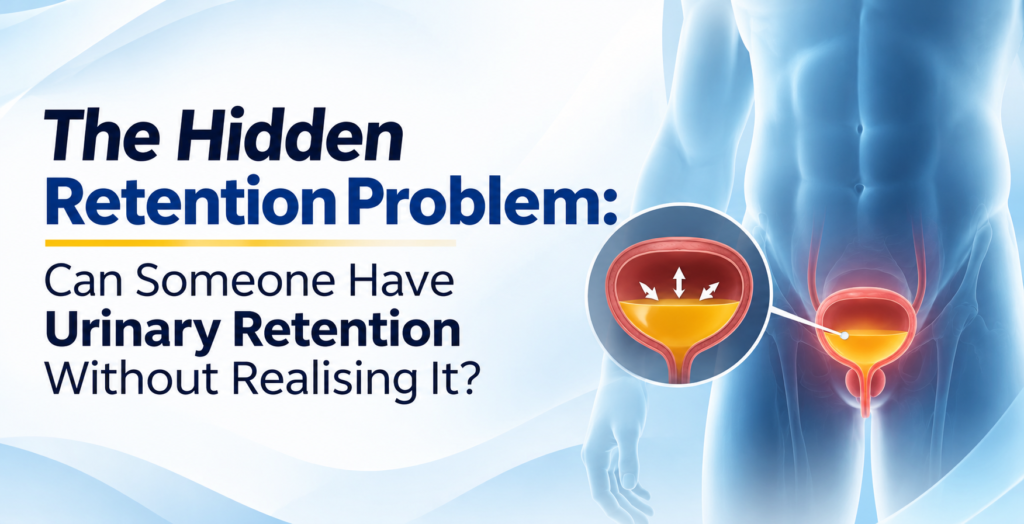
Think you’re emptying your bladder completely? Think again. Urinary retention doesn’t always announce itself with pain, discomfort or an inability to urinate. Sometimes, the bladder continues holding urine even after you think you’ve finished.
This is known as chronic urinary retention, and it can develop so gradually that people barely notice anything is wrong.
For many individuals, the warning signs are subtle: frequent bathroom visits, a weak urine stream, waking up multiple times at night or feeling that something isn’t quite right after urinating.
The surprising part? You may still be able to pass urine while experiencing significant urinary retention.
What Exactly Is Hidden Urinary Retention?
Urinary retention occurs when the bladder cannot empty completely.
There are two main types:
- Acute urinary retention: A sudden inability to pass urine, often accompanied by severe lower abdominal discomfort. This requires immediate medical attention.
- Chronic urinary retention: A gradual condition in which the bladder retains urine despite regular urination.
In chronic cases, the bladder may continue accumulating residual urine without producing obvious symptoms.
This is why urinary retention can remain undetected for months or even longer.
Why Does Urinary Retention Happen Without Obvious Symptoms?
Your bladder is designed to store urine and empty it when needed. However, this process depends on properly coordinated bladder muscles, nerves and an unobstructed urinary passage.
When something interferes with this system, urine may remain trapped inside the bladder.
Some common causes include:
1. Enlarged Prostate (BPH)
In men, particularly those over 50, an enlarged prostate can compress the urethra and restrict urine flow. The bladder may still empty partially, leaving urine behind.
2. Weak Bladder Muscles
Sometimes, the bladder muscles lose their ability to contract effectively. This can happen with ageing, diabetes or certain neurological conditions.
3. Nerve-Related Problems
Conditions such as Parkinson’s disease, multiple sclerosis, stroke and spinal cord injuries can interfere with the nerve signals responsible for bladder emptying.
4. Medications and Other Conditions
Certain antihistamines, antidepressants, decongestants and pain medications can contribute to urinary retention. Severe constipation and urinary tract infections can also interfere with normal urination. NIDDK+1
5 Subtle Signs Your Bladder May Not Be Emptying Completely
Urinary retention doesn’t always mean you cannot urinate. Watch out for these less obvious symptoms:
- Frequent urination: Feeling the need to visit the bathroom repeatedly, often passing small amounts.
- Weak urine stream: Urine flows slowly or stops and starts.
- Incomplete emptying: Feeling that your bladder is still full after urination.
- Night-time urination: Frequently waking up to urinate.
- Unexpected urine leakage: Small amounts of urine may leak because the bladder is excessively full.
These symptoms can overlap with other urinary conditions, so they should not be ignored. NIDDK+1
What Happens If Urinary Retention Goes Undetected?
This is where the problem becomes more serious.
When urine continuously remains inside the bladder, it can increase the risk of:
- Recurrent urinary tract infections (UTIs).
- Bladder muscle overstretching and damage.
- Overflow urinary incontinence.
- Pressure-related kidney damage in severe cases.
The important thing to understand is that the absence of pain does not necessarily mean the bladder is functioning normally. NIDDK+1
How Can Doctors Detect Hidden Urinary Retention?
The good news is that urinary retention can often be identified through simple diagnostic investigations.
A urologist may recommend:
1. Ultrasound of the Bladder: Helps assess bladder volume before and after urination.
2. Post-Void Residual (PVR) Test: Measures how much urine remains in the bladder after passing urine. This is one of the most important tests for identifying incomplete bladder emptying.
3. Uroflowmetry: Evaluates urine flow rate and identifies abnormalities in the urinary stream.
4. Urodynamic Testing: Assesses how well the bladder muscles and nerves work together.
5. Kidney Function Tests: Blood tests may be recommended to check whether prolonged retention has affected kidney function. NIDDK+1
Can Urinary Retention Be Treated?
Absolutely. Treatment depends on the underlying cause, the amount of retained urine and whether complications are present.
Depending on the diagnosis, treatment may include:
- Medications to manage prostate enlargement or improve urine flow.
- Catheterisation to drain retained urine when necessary.
- Minimally invasive procedures or prostate surgery for urinary obstruction.
- Treatment of underlying neurological or medical conditions.
Early diagnosis can help prevent long-term bladder and kidney complications. NIDDK+1
When Should You Consult a Urologist?
If you frequently experience a weak urine stream, incomplete bladder emptying, repeated urinary infections or unexplained urinary leakage, consider consulting a urologist.
Important: If you suddenly become unable to pass urine, especially with lower abdominal pain or swelling, seek emergency medical attention immediately. Do not wait for symptoms to settle on their own. NIDDK+1
The Takeaway: Don’t Confuse Urinating with Emptying
Passing urine doesn’t always mean your bladder is completely empty.
Chronic urinary retention can develop silently, particularly in older adults and men with prostate enlargement. Recognising subtle symptoms and getting the right diagnostic tests can make a significant difference.
Your bladder may not always tell you when something is wrong. Sometimes, the right investigation does.
Don’t ignore the signs. Consult a urologist and take care of your urinary health.